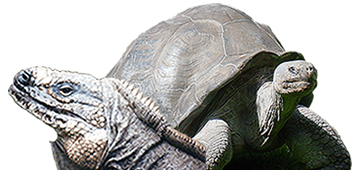
Cuban Iguana - {Cyclura Nubila}
Care Information
Life Span:
Size:
Food / Diet:
Feeding Procedures:
Habitat:
Born in 2010 Cubans Cyclura Nubila, also known as the Cuban rock iguana
Born in 2009 Cubans Cyclura Nubila, also known as the Cuban rock iguana
Cuban Iguana Overview
Cyclura nubila, also known as the Cuban rock iguana, Cuban ground iguana, or Cuban iguana, is a species of lizard of the iguana family. It is the largest of the West Indian rock iguanas (genus Cyclura), one of the most endangered groups of lizards. This herbivorous species with red eyes, a thick tail, and spiked jowls is one of the largest lizards in the Caribbean. The Cuban iguana is distributed throughout the rocky southern coastal areas of mainland Cuba and its surrounding islets with a feral population thriving on Isla Magueyes, Puerto Rico. It is also found on the Cayman Islands of Little Cayman and Cayman Brac, where a separate subspecies occurs. Females guard their nest sites and often nest in sites excavated by Cuban crocodiles. As a defense measure, the Cuban iguana often makes its home within or near prickly-pear cacti. Although the wild population is in decline because of predation by feral animals and habitat loss caused by human agricultural development, the numbers of iguanas have been bolstered as a result of captive-breeding and other conservation programs. Cyclura nubila has been used to study evolution and animal communication, and its captive-breeding program has been a model for other endangered lizards in the Caribbean.
Taxonomy In the Labem ZooThe Cuban rock iguana's generic name Cyclura is derived from the Ancient Greek cyclos meaning "circular" and ourá meaning "tail", after the thick-ringed tail characteristic of all Cyclura. John Edward Gray, the British zoologist who first described the species in 1831 as Iguana (Cyclura) nubila or "Clouded Guana", gave it the specific name nubila, Latin for "cloudy". The closest relatives of Cyclura nubila are the Grand Cayman blue iguana (Cyclura lewisi) and the Northern Bahamian rock iguana (Cyclura cychlura); phylogenetic analysis indicates that these three species diverged from a common ancestor three million years ago. Cyclura nubila was previously considered to have three subspecies, the Grand Cayman blue iguana (termed Cyclura nubila lewisi), the Lesser Caymans iguana (Cyclura nubila caymanensis), and the nominate Cuban subspecies (Cyclura nubila nubila). This classification was revised after later mitochondrial DNA analysis and research into the scalation patterns on the heads of Caribbean iguanid lizards (these patterns are unique by species and act as a "fingerprint" of sorts). The Grand Cayman blue iguana is now recognized as a separate species.
Anatomy and morphology In Prague ZooThe Cuban iguana is a large lizard, with an average body length of 46 centimeters (18 in) from snout to vent (the base of the tail). Individuals with lengths of more than 1.6 meters (5.2 ft) when measured from the snout to the tip of the tail have been recorded at the wildlife sanctuary within the Guantanamo Bay Naval Base (GTMO), Cuba. The species is sexually dimorphic: males are larger than females, and males have enlarged femoral pores on their thighs, which are used to release pheromones to attract mates and mark territory. The skin of male Cuban iguanas ranges in color from dark gray to brick red, whereas that of females is olive green with dark stripes or bands. In both sexes, limbs are black with pale brown oval spots and solid black feet. Young animals tend to be dark brown or green with faint darker striping or mottling in five to ten diagonal transverse bands on the body. These bands blend in with the body color as the iguana ages. Both sexes possess a dewlap (skin hanging below the neck) and a row of spines running down their back to their thick tail. Their heads and necks are short and stout, their teeth are solid and broad, and they have powerful jaw muscles. Their jowls, which grow larger as the animal ages, are covered in spiky protuberances called tubercles. The Cuban iguana's eyes have a golden iris and red sclera. Cuban iguanas have excellent vision and the ability to detect shapes and movement at long distances. Sensory cells called "double cones" give them sharp color vision and enable them to see ultraviolet wavelengths. By seeking out locations with more ultraviolet sunlight to bask in, the Cuban iguana optimizes vitamin D production. Cuban iguanas have poor low-light vision, because they have few rods or photoreceptor cells. Like other iguanids, Cuban iguanas have a white photosensory organ on the top of their heads, called the parietal eye. This "eye" has only a rudimentary retina and lens and cannot form images, but it is sensitive to changes in light and can detect movement.
Diet Like all Cyclura species, the Cuban iguana is primarily herbivorous; 95% of its diet consists of the leaves, flowers and fruits from as many as 30 plant species, including the seaside rock shrub (Rachicallis americana), thistle, prickly pear (Opuntia stricta), black mangrove (Avicennia germinans), red mangrove (Rhizophora mangle), olives, and various grasses. Aiding in the digestion of this high-cellulose diet, colonies of nematodes occupy 50% of the contents of Cuban iguanas' large intestines. Cuban iguanas occasionally consume animal matter, and individuals have been observed scavenging the corpses of birds, fish and crabs. Researchers on Isla Magueyes observed a single episode of cannibalism in 2006 when an adult female iguana chased, caught, and ate a hatchling. The researchers wrote that the dense population on Isla Magueyes could have caused this incident. Like other herbivorous lizards, the Cuban iguana is presented with a problem for osmoregulation: plant matter contains more potassium and has less nutritional content per gram than meat so more must be eaten to meet the lizard's metabolic needs. Unlike those of mammals, reptile kidneys cannot concentrate urine to save on water intake. Instead, reptiles excrete toxic nitrogenous wastes as solid uric acid through their cloaca. In the case of the Cuban iguana, which consumes large amounts of vegetation, these excess salt ions are excreted through the salt gland in the same manner as in birds.
Mating and behavior Cuban iguanas reach sexual maturity at an age of two to three years. Males are gregarious when immature, but become more aggressive as they age, vigorously defending territories in competition for females. Females are more tolerant of each other, except after laying their eggs. Mating occurs in May and June, and females lay single clutches of three to 30 eggs in June or July. According to field research, females deposit their eggs at the same nesting sites each year. The nests are built near each other as suitable nesting sites are becoming rare. On Cuba's Isla de Juventud, Cuban iguanas nest in pockets of earth exposed to the sun by Cuban crocodiles, after the crocodiles' eggs have hatched. These nests are separate from where adult iguanas live. In areas without crocodiles, the iguanas excavate nests in sandy beaches. At the San Diego Zoo, a female built a nest at the end of a long chamber she excavated in the sand. She stood near it for weeks, defending it by shaking her head and hissing at anyone who approached; this behavior demonstrated that Cuban iguanas guard their nest sites. The hatchlings spend several days to two weeks in the nest chamber from the time they hatch to the time they emerge from the nests; dispersing individually after emergence. Although Cuban iguanas typically remain still for long periods of time and have a slow lumbering gait due to their body mass, they are capable of quick bursts of speed for short distances. Younger animals are more arboreal and will seek refuge in trees, which they can climb with great agility. The animal is a capable swimmer and will take to nearby water if threatened. When cornered they can bite and lash their tails in defense.
Distribution and habitat Map of CubaThe Cuban iguana is naturally distributed in rocky coastal areas on Cuba and throughout as many as 4,000 islets surrounding the Cuban mainland, including Isla de la Juventud off the southern coast, which has one of the most robust populations. Relatively safe populations are found on some islets along the north and south coasts and in isolated protected areas on the mainland. These include Guanahacabibes Biosphere Reserve in the west, Desembarco del Granma National Park, Hatibonico Wildlife Refuge, Punta Negra-Quemados Ecological Reserve, and Delta del Cauto Wildlife Refuge, all in eastern Cuba. Because of this wide distribution, accurate information about the number of distinct subpopulations of Cuban iguanas cannot be determined. The population on the US Naval Base at Guantánamo Bay has been estimated at 2,000 to 3,000 individuals, and the animals are treated well and protected by US forces stationed at the base. An unusual incident occurred when a detainee in the prison assaulted a guard with a bloody tail torn from a Cuban iguana in May 2005. The subspecies, Cyclura nubila caymanensis, is endemic to the "Sister Islands" of Little Cayman and Cayman Brac. The population on Cayman Brac is less than 50 of these animals and Little Cayman supports 1,500. A feral population of C. n. caymanensis has been established on Grand Cayman. The Cuban iguana makes its burrow near cacti or thistles, sometimes even within the cactus itself. These thorny plants offer protection and their fruit and flowers offer the iguanas food. In areas without cacti, the lizards make their burrows in dead trees, hollow logs, and limestone crevices. In the mid-1960s a small group of Cuban iguanas was released from a zoo on Isla Magueyes, southwest of Puerto Rico, forming an independent free-ranging feral population. As of 2000, there has been talk of removing or relocating this population of iguanas by the US Department of Interior. This feral population is the source for 90% of the captive Cuban iguanas held in private collections and was the source for part of a study on animal communication and evolution conducted by Emilia Martins, a biologist at Indiana University. Martins' study compared the head-bob displays from the source population on Cuba with these animals on Isla Magueyes. The durations and pauses were longer by as much as 350% in the feral population. In comparison, the blue iguana of Grand Cayman's head-bob displays differed from those of the animals on Cuba by only about 20%. The rapid change in display structure between the colony of animals on Isla Magueyes and those on Cuba illustrated the potential of small founding population size as a catalyst to evolution with regard to communication or display. In this case the difference was by only six generations at most.
Terms of Service
The Legal stuff:
Federal Law requires tortoises sold as pets to be at least 4 inches. Tortoises 4 inches and over are legal Pet Shop Size these can be sold as pets (Please check your local & state laws). All tortoises less than 4" straight length are sold as per Federal guidelines 21CFR 1240.62, not sold as "pets" only sold for Scientific, Educational, Exhibition or Export purposes.
PLEASE READ:
All Sulcatas are captive raised on my farm, my farm has been raising tortoise for 25 years. All group lots of tortoise (over 10) are sold with a Vet Health Certificate (required for interstate travel). Note failure to read my terms & Conditions for any reason will not be a reason to consider them void or altered.
Live arrival & Health terms:
The high and low temperature range for the day must be above 40 and below 88 degrees (Shipping & Receiving locations). You or your agent must be present to sign for door to door shipments (First delivery attempt). Orders sent to the airport must be picked up within 4 hours of their arrival time. I am not responsible for missed deliveries or carrier delays. (Missed delivers void the live arrival & health guarantees)
30 Day Health Guarantee:
For animals bought in single lot quantities (No Health Certificate) Animals are guaranteed healthily, eating and acting normally. If you’re animal is sick or is not eating, you can return them prepaid shipping back to us and we will exchange the animal with free shipping back to you. Does not cover sudden death, the animal you send back must be live (Please see Live arrival & Health terms) your health guarantee may be void if the shipping terms were not meet. (Animals bought in Lots come with a health certificate and have been double insured healthy the 30 day health exchange does not apply). Guaranteed live arrival: Animals are guaranteed to arrive live providing our terms are met (please see Live arrival & Health terms). Animals that do not arrive a live will be replaced. No other guarantees or warrantees are implied or offered.
PAYMENT:
We except Bank wire transfer and prefer PayPal . We can send you an invoice thru PayPal or you can send PayPal money directly to sam@FloridaIguana.com. You can also pay by certified check or personal check (allow time to clear). We are happy to hold animals with a 20% non-refundable deposit.
SHIPPING:
We offer Next day UPS service from here if the weather is safe. UPS offers no insurance on livestock (your risk). Most small UPS orders are $45. Other shipping methods available: For large orders we can ship by airlines (Delta is best out of Ft Lauderdale FL) with insurance. Most small air shipments are $85. If you’re paying by PayPal, we only ship to confirmed PayPal address
Note that all door-to-door orders must have someone available to receive and sign for the package (at the first attempt of delivery) or the Health Guarantee is void. All shipping rates noted above are estimates and vary depending on location and order size. Please provide address for a shipping quote.
PHOTOS:
The photos in this ad may or may not be the actual animal (unless other wise noted). Additional photos available by request.
CONTACT:
Email is the best way to contact me: Sam@FloridaIguana.com
Florida Iguana & Tortoises Breeders
Cooper City FL
www.floridaiguana.com
sam@floridaiguana.com