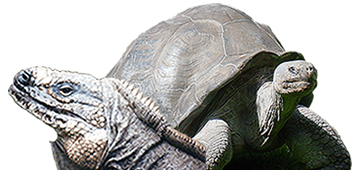
Red-Foot Tortoise - {Geochelone carbonaria}

Red-Foot Tortoise

Care Information

Life Span: 40 to 50+ years
Size: Up to 10 to 16 Inches long and 20 lbs. when full grown
Food / Diet: Your tortoise will need a diet high in fiber and calcium and low in fat and protein from a plant-based source. Hays and dark greens that are pesticide-free should provide three fourths of the diet. The remaining quarter of the diet should include organic romaine lettuce, collard greens, rye grass, clovers. Fruit may be offered as an occasional treat.
Feeding Procedures: Each day calcium should be dusted on vegetables should be shopped into small pieces and provided in variety to avoid diseases. Once a week vitamin and mineral supplements should be added to the food to help provide a healty diet for your tortoise.
Habitat:

Red Foot Tortoise #1 from Group A

SKU: RD1GA

Only: $179.95

Red Foot Tortoise #2 from Group A

SKU: RD2GA

Only: $179.95

Red Foot Tortoise #3 from Group A

SKU: RD3GA

Only: $179.95

Red Foot Tortoise #4 from Group A

SKU: RD4GA

Only: $179.95

Red Foot Tortoise #5 from Group A

SKU: RD5GA

Only: $179.95

Red Foot Tortoise #6 from Group A

SKU: RD6GA

Only: $179.95

Red Foot Tortoise #7 from Group A

SKU: RD7GA

Only: $179.95

Red Foot Tortoise #8 from Group A

SKU: RD8GA

Only: $179.95

Red Foot Tortoise #9 from Group A

SKU: RD9GA

Only: $179.95

Red Foot Tortoise #10 from Group A

SKU: RD10GA

Only: $179.95

Hatchling Captive Bred Red Foot Tortoise

SKU: RDHCB

Only: $99.95

3 to 4 Inch Captive Bred Red Foot Tortoise

SKU: RD34CB

Only: $199.95

6 Inch Captive Bred Red Foot Tortoise

SKU: RD6CB

Only: $279.95

Photos


Red-Foot Tortoise Overview

Redfoot tortoises have red scales on the limbs, as well as red, yellow, and/or orange facial markings. Redfoots will normally reach between 10 and 14 inches (25.4 - 35.6 cm) in carapace length, although in rare cases may grow up to 16 inches (40 cm). There is also a smaller phenotype commonly called the 'cherryhead' redfoot, which can be identified by its' bulbous nose and darker plastron. This phenotype, which does not bear subspecies classification at this time, ranges in size as an adult from 10-12 inches (25 ~ 30 cm).
Redfoot males are larger than females in carapace length and weight, but are not wider or taller. Males can easily reach twenty pounds (9 kg) or more, while females weigh a bit less. As with other tortoise species, male redfoots have a concave plastron. As redfoots mature, both sexes develop a unique mid-body constriction (some have referred to it as a "waist") that, from a top view, gives the tortoises a decidedly hourglass appearance. This "hourglass" figure is much more developed in males than in females. Mature males also have longer and wider tails than females.
A redfoot tortoise generally lives 40 to 50 years.

Care
A properly cared-for redfoot is one of the best tortoise species to maintain in captivity. As with any animal, one should put in a great deal of research and deliberation before obtaining a redfoot as a pet. One should be sure that there is a doctor of veterinary medicine with experience with exotic animals including tortoises (preferably redfoots) in the area before obtaining one. In addition, many states prohibit exotic species and one must be aware of local laws before getting a redfoot of one's own.
Indoor habitats Redfoot tortoises need a temperature of between 80 and 90F. An indoor enclosure should be kept at 80 percent ambient humidity.
Cypress mulch may be the best substrate for redfoot tortoises because of the way it simultaneously holds moisture, yet dries out quickly. Other types of substrate may be too moist or too dry, such as coconut husk or newspaper, possibly leading to dermatitis and fungal infections. Sphagnum moss also helps retain moisture inside the enclosure.
There is some debate about whether redfoots need a source of broad-spectrum UV lighting. Some sources state that redfoots need a source of UVB lighting to ensure proper synthesis of vitamin D3, which is needed to metabolize calcium and thus maintain bone density. However, other sources state that because the redfoot is a rainforest species and has little exposure to sunlight in its natural habitat, its vitamin D3 needs are derived primarily from its diet and UVB light may actually be harmful. "Red-foot and Yellow-foot tortoises do not bask to the same extent as arid-habitat species, and therefore obtain much of their D3 needs in nature from the animal component of their diet". - Highfield 2002. An aquarium bulb may be used in place of a UVB light.
Redfoots should also have a shallow water dish that allows them to soak because it is very easy for them to become dehydrated and they can absorb water transdermally. Some sources state that redfoots should be given a forced soaking periodically. Other sources state that redfoots should not be forced to soak, but rather will simply soak themselves as needed if provided a water dish.
Hatchling tortoises have been successfully raised in a 16"x24"x6" enclosure. Juvenile tortoises have been successfully raised in a 28"x15"x13" Rubbermaid container, with a 100 watt porcelain heat emitter and an aquarium bulb as a light source.

Feeding
Redfoot tortoises are omnivorous. In captivity, redfoots should be fed a mixture of high calcium greens, fruits, vegetables, and flowers and a small amount of animal protein.
Appropriate high calcium greens include dandelion greens,lettes, endive, escarole, mustard greens, collard greens, turnip greens, grape leaves, and hibiscus leaves. Spinach and kale should be fed sparingly, as they contains oxalates that bind dietary calcium, making it unavailable.
Flowers are also a common food of choice in the wild. Edible flowers include hibiscus, nasturtium, prickly-pear flowers, and dandelions.
Good fruits to offer include strawberries, peaches, pineapples, plums, papayas, mangoes, kiwis, melons, cantaloupes, and prickly pear fruits. Banana should be fed seldom, if at all.
Redfoots have been known to eat carrion in the wild; therefore, animal protein is a crucial component in a redfoot's diet. One meal per week consisting of re-hydrated dried cat foots with additional minerals and vitamins added is sufficient. One source recommends pure calcium carbonate powder with no vitamin D3.
Red Foot tortoises in particular seem very sensitive to environmental change. When first acquiring a red foot, expect a possible long period of fasting. Just when one thinks something is terribly wrong, the redfoot will suddenly start eating again once she/he feels comfortable with the surrounding (SFCRC - 2003). This fasting aspect is more prominent and longer in duration in WC (wild caught) individuals than with long term captives or CB (captive bred) individuals.

Taxonomy and etymology

Range and habitat
The redfoot tortoise is found throughout extreme southern Central America, and central and northern South America including the countries of Panama, Colombia, Venezuela, Guyana, Surinam, French Guyana, Brazil, Bolivia, Paraguay, and Argentina. They are also found on Trinidad, Barbados, Saint Lucia etc.. and have been introduced to many other islands in the West Indies.
The redfoot occupies a number of habitats within this extensive range. It occurs in all types of forest habitat (rainforest, temperate forest, and dry thorn forest), and also dwells in savanna areas, including man-made grasslands resulting from ranching and slash-and-burn agricultural practices. Forest edges and savannas seem to be the preferred habitat for this species, although there is some disagreement over this. Walker (1989) states that red-foots prefer grasslands and dry forest areas, and that rain-forest habitat is most likely marginal. Other authors however, state or suggest that humid forest is the preferred habitat (Legler, 1963) (Moskovits, 1988).

Size and lifespan

Breeding
In the wild, the redfoot tortoise lays clutches of 5 to 15 eggs between July and September. They are generally buried in a nest in the ground in typical tortoise style.[8] However, some authors report that locals in Panama have observed eggs laid in leaf-litter on the forest floor.[8] Eggs are oblong (about 2" x 1.5") and have brittle shells. The hatchlings are round and flat, and are about 1.5" in diameter.
In captivity, redfoot tortoises are capable of producing eggs at any time during the year, although seasonal activity may be noted.
It is important that more than one male be included in a breeding group, male to male combat is important in inducing breeding in redfoots. Male to male combat begins with a round of head bobbing from each male involved, and then proceeds to a wresting match where the males attempt to turn one another over. The succeeding male (usually the largest male) then attempts to mate with the females. The ritualistic head movements displayed by male red-foots are thought to be a method of species recognition. Other tortoise species, most notably the closely related and sometimes sympatric yellow-footed tortoise (Geochelone denticulata), have different challenging head movements. Redfoot tortoises have challenging head movements that are a series of lateral jerks, by contrast, yellow-footed tortoises utilize a long sideways sweep in their displays. Male redfoots peruse walking (seeming uninterested) females until they can maneuver them into a position for mating. The unique body shape of the male redfooted tortoise facilitates the mating process by allowing him to maintain his balance during copulation while the female walks around, seemingly attempting to dislodge the male by walking under low-hanging vegetation.


Terms of Service

The Legal stuff:
Federal Law requires tortoises sold as pets to be at least 4 inches. Tortoises 4 inches and over are legal Pet Shop Size these can be sold as pets (Please check your local & state laws). All tortoises less than 4" straight length are sold as per Federal guidelines 21CFR 1240.62, not sold as "pets" only sold for Scientific, Educational, Exhibition or Export purposes.

PLEASE READ:
All Sulcatas are captive raised on my farm, my farm has been raising tortoise for 25 years. All group lots of tortoise (over 10) are sold with a Vet Health Certificate (required for interstate travel). Note failure to read my terms & Conditions for any reason will not be a reason to consider them void or altered.

Live arrival & Health terms:
The high and low temperature range for the day must be above 40 and below 88 degrees (Shipping & Receiving locations). You or your agent must be present to sign for door to door shipments (First delivery attempt). Orders sent to the airport must be picked up within 4 hours of their arrival time. I am not responsible for missed deliveries or carrier delays. (Missed delivers void the live arrival & health guarantees)

30 Day Health Guarantee:
For animals bought in single lot quantities (No Health Certificate) Animals are guaranteed healthily, eating and acting normally. If you’re animal is sick or is not eating, you can return them prepaid shipping back to us and we will exchange the animal with free shipping back to you. Does not cover sudden death, the animal you send back must be live (Please see Live arrival & Health terms) your health guarantee may be void if the shipping terms were not meet. (Animals bought in Lots come with a health certificate and have been double insured healthy the 30 day health exchange does not apply). Guaranteed live arrival: Animals are guaranteed to arrive live providing our terms are met (please see Live arrival & Health terms). Animals that do not arrive a live will be replaced. No other guarantees or warrantees are implied or offered.

PAYMENT:
We except Bank wire transfer and prefer PayPal . We can send you an invoice thru PayPal or you can send PayPal money directly to sam@FloridaIguana.com. You can also pay by certified check or personal check (allow time to clear). We are happy to hold animals with a 20% non-refundable deposit.

SHIPPING:
We offer Next day UPS service from here if the weather is safe. UPS offers no insurance on livestock (your risk). Most small UPS orders are $45. Other shipping methods available: For large orders we can ship by airlines (Delta is best out of Ft Lauderdale FL) with insurance. Most small air shipments are $85. If you’re paying by PayPal, we only ship to confirmed PayPal address

Note that all door-to-door orders must have someone available to receive and sign for the package (at the first attempt of delivery) or the Health Guarantee is void. All shipping rates noted above are estimates and vary depending on location and order size. Please provide address for a shipping quote.

PHOTOS:
The photos in this ad may or may not be the actual animal (unless other wise noted). Additional photos available by request.

CONTACT:
Email is the best way to contact me: Sam@FloridaIguana.com
Florida Iguana & Tortoises Breeders
Cooper City FL
www.floridaiguana.com
sam@floridaiguana.com