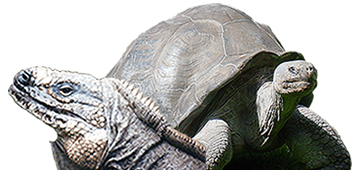
Yellow Foot Tortoise - {Geochelone denticulata}

Yellow Foot Tortoise

Care Information

Life Span: 20+ years
Size: Males up to 13.5 Inches long Females up to 11.25 Inches long
Food / Diet: Your tortoise will need a diet high in fiber and calcium and low in fat and protein from a plant-based source. Hays and dark greens that are pesticide-free should provide three fourths of the diet. The remaining quarter of the diet should include organic romaine lettuce, collard greens, rye grass, clovers. Fruit may be offered as an occasional treat.
Feeding Procedures: Each day calcium should be dusted on vegetables should be shopped into small pieces and provided in variety to avoid diseases. Once a week vitamin and mineral supplements should be added to the food to help provide a healty diet for your tortoise.
Habitat:

Hatchling Captive Bred Yellow Foot Tortoise

SKU: YFH

Only: $129.95

3 to 4 Inch Captive Bred Yellow Foot Tortoise

SKU: YF3

Only: $159.95

6 Inch Captive Bred Yellow Foot Tortoise

SKU: YF6

Only: $199.95

Photos


Yellow Foot Tortoise Overview

The Brazilian Giant Tortoise, Forest Tortoise, South American Tortoise, South American Yellow-footed Tortoise, or Yellow-footed Tortoise (Geochelone denticulata) is a species of turtle in the Testudinidae family. It is found in Bolivia, Brazil, Colombia, Ecuador, French Guiana, Guyana, Peru, Suriname, Trinidad and Tobago, and Venezuela.
There are several yellow head scales and a horizontal bar behind its eye. The carapace (shell top) is black with a small, distinct yellow area around the areola on each scute (shell scale). Adult males reach a length of up to 13.5 inches (30.4 cm) in length, while the maximum size of females is 11.25 inches (28.9 cm) in length. Mature specimens have distinctive incurving of sides, giving them a well-defined "waist". The plastron (shell bottom) is a relatively bland yellow-brown; there may be some reddish tint and vague dark marks along areas of more recent growth. The plastron is extremely concave in adult males. Consequently, the male is much lighter than the female. The female has a very flat plastron and short, stubby tail. There is quite a bit of variation in coloring, with the legs and head often having patches of orange, yellow or red. The skin is black with bright yellow marks on the head and lower jaw. Many of the scales on the limbs and tail are bright scarlet. Specimens from west of the Andes have a grayish or brownish carapace. Light limb scales are yellowish or slightly orange, but not scarlet. The plastron ranges from predominantly yellow to black. Note: There is considerable variation in color over the range of the red-foot tortoise, so no one description will accurately describe every specimen.
This species is sexually dimorphic and it is easy to distinguish male and female. The male has an extreme plastral concavity and is subsequently much lighter. There is a pinching off at the midsection of the carapace. The female is much heavier, with a flat plastron and more symmetrical, curved carapace. The female also has a shorter tail compared to the male. The male is quite vocal at mating time with a low moan produced.
The Yellow foot tortoise is much larger with constant yellow markings compared to the red foot tortoise (Geochelone carbonaria).

Behavior
These turtles make a sound like a baby cooing with a raspy voice. Tortoises also identify each other using body language. The male tortoise makes head movements toward other males, but the females do not make these head movements. Male tortoises also swing their heads back and forth in a continuous rhythm as a mating ritual. Mating occurs all year round for the Yellow Footed Tortoise. There is no parental care of the young and the baby tortoises will fend for themselves, starting by eating calcium rich vegetables.

Feeding
This South American tortoise eats many kinds of foliage. They are too slow to capture any fast animals. In the wild, their diet consist of grasses, fallen fruit, camion, plants, bones, mushrooms, excrement, and slow moving animals such as snails, worms, and others they are able to capture. In captivity, they are fed oranges, apples, melons, endive, collard greens, Dandilions,plantain, ribwort, clover shredded carrots, insects, worms, cuttlebone, tortoise vitamins, edable flowers, and alfalfa pellets. Each Yellow Footed Tortoise in the wild reaches the age of maturity at about 8–10 years. The fecundity of a female generally depends on the size, the bigger they are, the more eggs they can produce. On average, a female will create approximately 6–16 eggs per year, although some female individuals may not reproduce each year. The eggs have brittle shells and are elongated to spherical, approximately 3–6 cm in diameter. The egg size will increase with the body size of the turtle. The young are self-sufficient from birth. The Yellow Footed Tortoise can live for approximately 50-60 years.

Range and habitat
There is some disagreement as to which habitat is the preferred type for red-footed tortoises. Some feel that red-foots prefer grasslands and dry forest areas, and that rain-forest habitat is most likely marginal. Others suggest that humid forest is the preferred habitat. Regardless, they are found in drier forest areas, grasslands, and the savanna, or rainforest belts adjoining more open habitats. The red-footed tortoise shares some of its range with the yellow-footed tortoise. In ranges that are shared in Surinam, the red-footed tortoise has moved out of the forests into grasslands (that are a result of slash and burn agriculture) while the yellow-footed tortoise has remained in the forest.

Size and lifespan


Terms of Service

The Legal stuff:
Federal Law requires tortoises sold as pets to be at least 4 inches. Tortoises 4 inches and over are legal Pet Shop Size these can be sold as pets (Please check your local & state laws). All tortoises less than 4" straight length are sold as per Federal guidelines 21CFR 1240.62, not sold as "pets" only sold for Scientific, Educational, Exhibition or Export purposes.

PLEASE READ:
All Sulcatas are captive raised on my farm, my farm has been raising tortoise for 25 years. All group lots of tortoise (over 10) are sold with a Vet Health Certificate (required for interstate travel). Note failure to read my terms & Conditions for any reason will not be a reason to consider them void or altered.

Live arrival & Health terms:
The high and low temperature range for the day must be above 40 and below 88 degrees (Shipping & Receiving locations). You or your agent must be present to sign for door to door shipments (First delivery attempt). Orders sent to the airport must be picked up within 4 hours of their arrival time. I am not responsible for missed deliveries or carrier delays. (Missed delivers void the live arrival & health guarantees)

30 Day Health Guarantee:
For animals bought in single lot quantities (No Health Certificate) Animals are guaranteed healthily, eating and acting normally. If you’re animal is sick or is not eating, you can return them prepaid shipping back to us and we will exchange the animal with free shipping back to you. Does not cover sudden death, the animal you send back must be live (Please see Live arrival & Health terms) your health guarantee may be void if the shipping terms were not meet. (Animals bought in Lots come with a health certificate and have been double insured healthy the 30 day health exchange does not apply). Guaranteed live arrival: Animals are guaranteed to arrive live providing our terms are met (please see Live arrival & Health terms). Animals that do not arrive a live will be replaced. No other guarantees or warrantees are implied or offered.

PAYMENT:
We except Bank wire transfer and prefer PayPal . We can send you an invoice thru PayPal or you can send PayPal money directly to sam@FloridaIguana.com. You can also pay by certified check or personal check (allow time to clear). We are happy to hold animals with a 20% non-refundable deposit.

SHIPPING:
We offer Next day UPS service from here if the weather is safe. UPS offers no insurance on livestock (your risk). Most small UPS orders are $45. Other shipping methods available: For large orders we can ship by airlines (Delta is best out of Ft Lauderdale FL) with insurance. Most small air shipments are $85. If you’re paying by PayPal, we only ship to confirmed PayPal address

Note that all door-to-door orders must have someone available to receive and sign for the package (at the first attempt of delivery) or the Health Guarantee is void. All shipping rates noted above are estimates and vary depending on location and order size. Please provide address for a shipping quote.

PHOTOS:
The photos in this ad may or may not be the actual animal (unless other wise noted). Additional photos available by request.

CONTACT:
Email is the best way to contact me: Sam@FloridaIguana.com
Florida Iguana & Tortoises Breeders
Cooper City FL
www.floridaiguana.com
sam@floridaiguana.com